Many people try to build an “AI brain” by installing Obsidian, creating a few folders, and dropping every useful file into the same vault.
But a large archive is not the same thing as a reliable context system.
The source presents three common options: Google Drive, Notion, and Obsidian. Each one represents a different trade-off. Google Drive is familiar and easy to deploy, but it still behaves mainly like a folder system. Notion adds databases, metadata, and collaboration. Obsidian stores information as local Markdown files, making the data easier to read, link, export, and move.
The important question is not which tool looks most like a “second brain.”
The real value sits in the information architecture built above the tool.
🧩 In the source, the system separates context into categories such as:
* People
* Projects
* Decisions
* Companies
* Meetings
* Knowledge
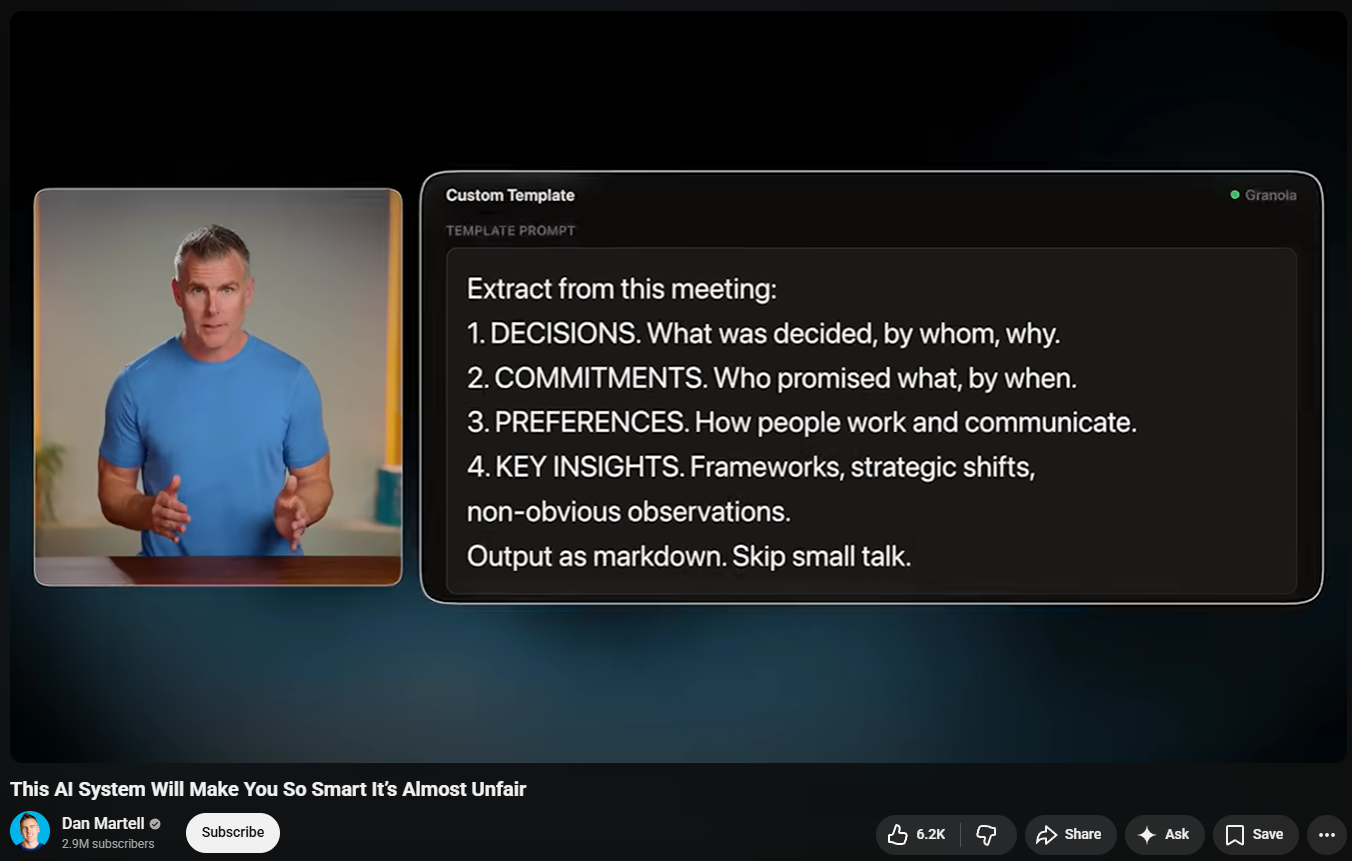
That structure changes how the data can be used. A meeting transcript is not simply saved and forgotten. AI is expected to extract decisions, commitments, working preferences, and useful insights, then place each item in the right location.
The stack also includes a processing layer. It can find isolated notes, create files for new entities, merge duplicated information, update summary pages, and flag content that needs review. This maintenance layer is what turns storage into a knowledge system that can support future AI workflows.
Without it, the business may have plenty of data but very little usable context.
That distinction matters because the same information may need to support several workflows over time. A future agent may need to prepare a meeting brief, summarize the history of a project, identify unresolved decisions, or retrieve the latest context about a customer. If the underlying data is inconsistent, poorly named, or scattered across incompatible formats, every new workflow has to rebuild the same context from scratch.
⚠️ More automation also creates more data risk.
An AI system can link the wrong person to a note, merge records that should remain separate, or turn an interpretation into a “fact” that gets reused later. Identity files, preference notes, and style profiles can also make the system repeat old assumptions rather than challenge them.
That is why the stack should not be selected by feature count alone.
The practical choice depends on how the knowledge will be used:
* If several people need to collaborate, permissions and database structure matter.
* If long-term ownership is the priority, open formats and reliable export matter.
* If automation is central, APIs, connectors, and change history matter.
* If trust is important, every extracted conclusion should retain its source and require approval before AI changes the original record.
This is where the three tools create different operating models.
Google Drive is easy to start with and may be enough when the workflow mainly involves shared files and familiar folders. Notion becomes more useful when the team needs collaboration, structured records, and database views. Obsidian is attractive when local ownership, Markdown, portability, and long-term access matter more than built-in team collaboration.
None of them creates an AI brain by itself.
The stronger system is the one that preserves context in a form that remains understandable to people, accessible to future tools, and traceable back to its source. Storage is only the first layer. Structure, capture, processing, cleanup, and governance determine whether that storage can support reliable AI work later.
So the better question is not, “Should we use Notion or Obsidian?”
A better question is, “What context must the business preserve, who needs access to it, what may AI change, and how will every conclusion be traced back to evidence?”
A useful AI brain is not the place that stores the most information.
It is the data stack where context is structured well enough for AI to retrieve the right information, extract the right meaning, and avoid quietly corrupting the organization’s memory.
#SaaSStackGuide #KnowledgeManagement #AIWorkflow #DataArchitecture #BusinessOperations