In the rapidly evolving world of eCommerce, the barrier to entry has never been lower, yet the competition has never been fiercer. If you are reading this, you are likely looking for a way to monetize your creativity or scale an existing brand without the nightmare of inventory management. Over the last five years, I have tested dozens of platforms, from obscure local printers to massive global fulfillers. However, one name keeps coming up in every Printful review: Printful.
But is it actually worth the hype in 2025?
As we see a surge in creators using the best AI tools for graphic design, the need for a reliable physical infrastructure to sell those designs is critical. Printful positions itself not just as a printing service, but as a robust SaaS (Software as a Service) solution that automates the messy side of business—printing, packing, and shipping.
In this deep-dive review, I will share my honest, hands-on experience with Printful. We will dissect its features, analyze its pricing structure, and determine if it truly is one of the essential AI productivity tools in 2025 and beyond for eCommerce automation.
Overview of Printful
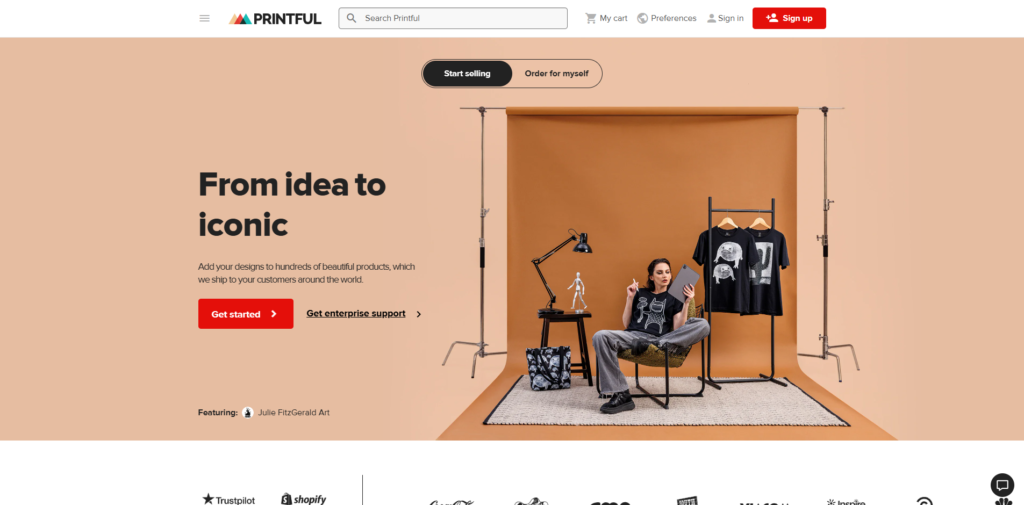
At its core, Printful is a Print-on-Demand (POD) and dropshipping aggregator. Unlike traditional manufacturing where you must order 500 t-shirts upfront and hope they sell, Printful allows you to sell products first, and pay later.
Here is the concept: You create a digital store (on Shopify, Etsy, WooCommerce, etc.) and sync it with Printful. When a customer buys a hoodie from your store, the order is automatically sent to Printful. They print your design on the hoodie, pack it, and ship it directly to your customer under your brand name. You never touch the product.
While many competitors have emerged, Printful remains the industry leader due to its heavy investment in technology. They operate as a high-tech SaaS platform, offering seamless API integrations and a global network of fulfillment centers in the USA, Canada, Europe, and Mexico. For anyone looking to leverage AI tools to generate designs and immediately monetize them, Printful provides the physical infrastructure to make that happen.
Key Features & Benefits
Printful is feature-rich, which can be overwhelming for beginners. Based on my usage, here are the features that actually move the needle for a business.
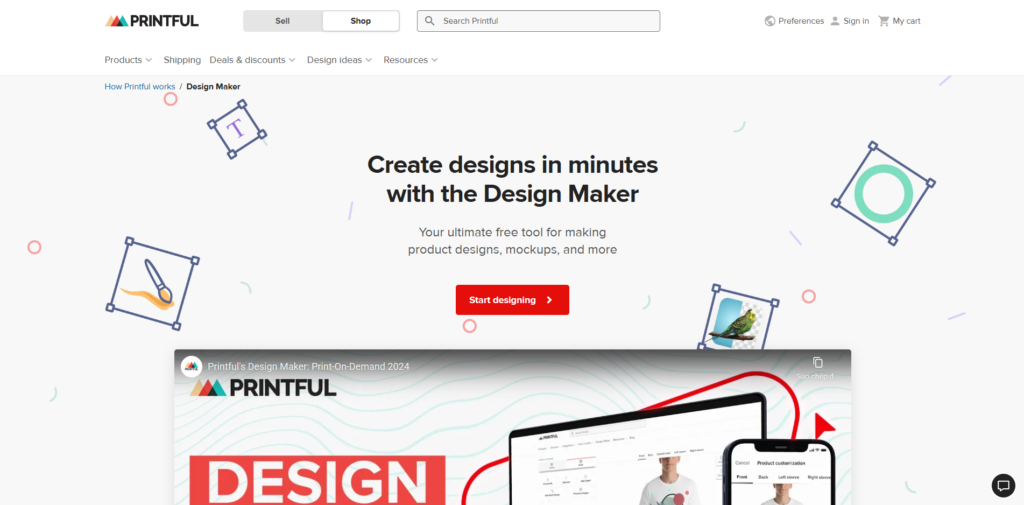
The Advanced Mockup Generator
If you are looking for the best AI tools for eCommerce design, you might be surprised to find that Printful’s internal Mockup Generator is incredibly powerful. It allows you to upload your artwork and visualize it on hundreds of products in real-time.
- Benefit: You don’t need to hire a photographer or buy expensive samples immediately. You can generate high-quality lifestyle images of models wearing your clothes to use on your website and social media ads.
Global Fulfillment Network
One of the biggest pain points in dropshipping is shipping times. Printful has internal facilities across the globe.
- Benefit: If a customer orders from Germany, the item is likely printed in their European facility (like Latvia or Spain), not shipped from the US. This drastically reduces shipping costs and delivery times, leading to higher customer satisfaction.
White-Label Branding
When your customer receives the package, you want them to remember your brand, not Printful.
- Benefit: Printful allows for custom branding options. You can place your logo on the packing slip, and for certain products, you can even add custom inside labels or outside branding patches. This elevates the perceived value of your product significantly.
Extensive Product Catalog
They offer far more than just T-shirts. Their catalog includes embroidery, all-over print (AOP) clothing, home decor (mugs, posters), accessories, and even tech gear like phone cases.
- Benefit: This allows you to scale and pivot. If T-shirts aren’t selling, you can instantly launch a line of embroidered hats or tote bags without any financial risk.
Ideal Users / Use Cases
Who is Printful actually built for? While anyone can sign up, I’ve found it fits three specific user profiles best.
The AI-Enhanced Entrepreneur
With the rise of generative technology, many users are creating stunning artwork using Midjourney or DALL-E. Printful is the perfect execution partner for these creators. You can take a design generated by AI tools, upscale it, and sync it to Printful in minutes. It effectively turns your AI art into a physical merchandise business instantly.
E-commerce Store Owners (Shopify/Etsy)
If you already run a store and want to expand your catalog without buying inventory, Printful is the gold standard. The integration with Shopify is flawless. It automates the entire process, making it one of the top AI productivity tools in 2025 for business owners who want to automate tedious fulfillment tasks.
Musicians, YouTubers, and Influencers
For creators who want to sell merch but don’t have the time to pack boxes in their garage, Printful is a lifesaver. You can focus on content creation while the SaaS backend handles the logistics of your merchandise sales.
How It Works: From Design to Delivery
Understanding the workflow is crucial to seeing the value of this platform. Here is the step-by-step process I went through when setting up my first shop.
Step 1: Create an Account and Connect Your Store First, you sign up for a Printful account (which is free). Then, you navigate to the dashboard and connect your eCommerce platform. I tested this with Shopify and Etsy. The synchronization takes about two minutes.
Step 2: Product Creation You select a product (e.g., the Bella + Canvas 3001 T-shirt). You upload your design file. This is where you use the Mockup Generator to position your art, choose thread colors for embroidery, or adjust patterns for all-over prints.
Step 3: Push to Store Once you are happy with the design, you click “Proceed to Media,” select your mockup images, write your description, set your retail price, and click “Submit to Store.” The product instantly appears on your Shopify or Etsy storefront as a purchasable item.
Step 4: The Automated Sale Here is the magic. When a customer buys that shirt on your site for $30, two things happen:
- You receive the $30 from the customer.
- Your store automatically notifies Printful. Printful charges your credit card for the base cost (e.g., $15) plus shipping.
- You keep the profit ($15 minus expenses).
- Printful prints, packs, and ships the item to the customer with a tracking number, which is automatically sent back to your store to notify the customer.
Pricing
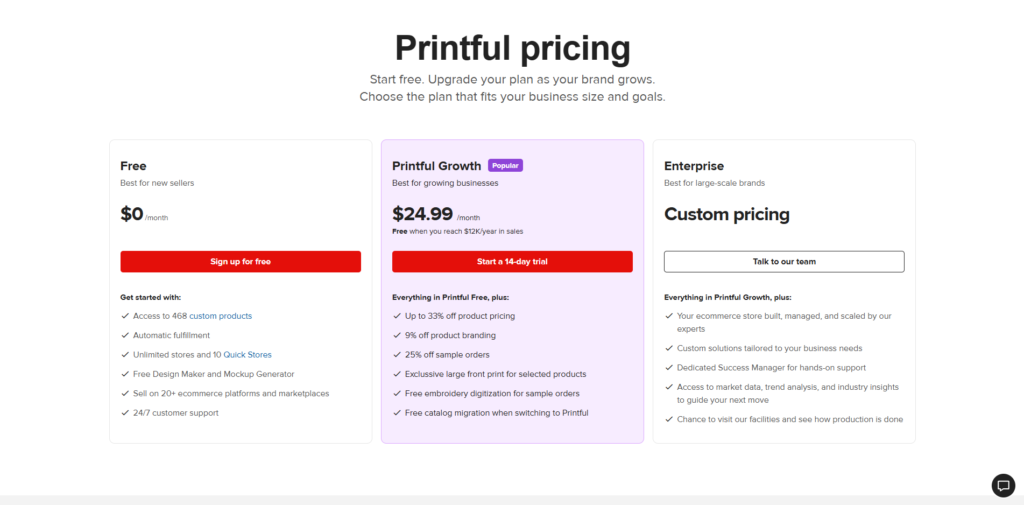
Printful operates on a transaction-based model, but they have recently introduced membership tiers. Understanding this is key to your profitability.
Free Plan (Pay-as-you-go)
There is no monthly subscription fee to use Printful. You only pay when you make a sale.
- Cost: You pay the base price of the product + shipping.
- Example: A standard T-shirt might cost you $12.95 (base price). If you sell it for $25.00, your gross profit is $12.05 (before shipping and platform fees).
Printful Growth Membership
For higher-volume sellers, Printful offers a “Growth” membership.
- Cost: This is usually achieved by reaching a certain sales threshold (e.g., $12k/year) or paying a monthly fee.
- Benefit: You get significant discounts on product prices (up to 20% off DTG products and 30% off other categories). If you are scaling, this membership is essential to improve your margins.
It is important to note that while Printful is not the cheapest option on the market, you are paying for reliability and software quality. Cheaper competitors often lack the robust API and quality control that Printful provides.
Pros & Cons
In my years of writing every major Printful review, I have learned that no tool is perfect. Here is an honest breakdown of the strengths and weaknesses based on my experience.
The Pros
First and foremost, the quality consistency is superior to most competitors. While POD will never be as perfect as a bulk screen print run, Printful’s Direct-to-Garment (DTG) printing is vibrant and durable. I have washed my sample shirts dozens of times, and the prints hold up well.
Secondly, the ease of use and automation is top-tier. The dashboard is intuitive, clean, and beginner-friendly. If you are looking for best AI tools for dropshipping automation, Printful fits the bill because once you set it up, it runs on autopilot. You can literally make money while you sleep.
Thirdly, the product range is massive. Being able to sell embroidered hats, engraved jewelry, and printed hoodies from the same dashboard simplifies logistics immensely.
The Cons
The biggest downside is profit margins. Because the base price of items is higher than buying in bulk, your profit per unit is lower. You have to sell at a premium price point to make significant money. You are trading margin for convenience and lack of risk.
Another issue can be production times during holidays. During Q4 (Christmas season), fulfillment times can stretch from 3 days to 7-10 days. This is an industry-wide issue, but it is something you must communicate to your customers to avoid complaints.
Finally, customer service can sometimes be slow. While they have live chat, resolving complex issues regarding lost packages or print errors can sometimes take a few days of back-and-forth emails.
FAQs
Is Printful really free to use?
Yes, there are no upfront costs or monthly subscription fees to start. You only pay Printful when a customer pays you. However, you will need to pay for your own eCommerce platform (like Shopify) or marketplace fees (like Etsy).
Can I use AI-generated art on Printful products?
Absolutely. Many top sellers use the best AI tools for art generation (like Midjourney) to create designs. As long as the image resolution is high enough (usually 300 DPI is recommended for best quality), Printful will print it.
How does Printful compare to Printify?
This is the most common question. Printify connects you to a network of third-party printers, meaning quality can vary between providers, but prices are generally lower. Printful owns its own printing facilities, meaning prices are slightly higher, but quality consistency and branding options are generally better.
Does Printful handle returns?
Printful only accepts returns if the item is damaged or there is a printing error. They do not accept returns for “buyer’s remorse” (e.g., the customer ordered the wrong size). You will need to set up your own return policy on your store to handle size exchanges.
Is Printful suitable for a full-time business?
Yes. Many six and seven-figure brands run entirely on Printful’s infrastructure. The key is eventually moving to the “Printful Growth” pricing tier to maximize your profit margins as you scale.
Conclusion
After years of testing and fulfilling thousands of orders, my verdict is clear: Printful remains the most robust, reliable, and user-friendly Print-on-Demand solution on the market in 2025.
While it is not the cheapest option per unit, it is the safest bet for building a long-term brand. The seamless integration with major platforms, the high-quality mockup generator, and the global fulfillment network make it an indispensable tool for modern entrepreneurs.
If you are looking to leverage the best AI tools for business and creativity, you need a physical fulfillment partner that can keep up with the speed of innovation. Printful is that partner. It allows you to test ideas rapidly, scale without inventory risk, and build a professional brand from your laptop.
Ready to start your eCommerce empire?
Don’t let analysis paralysis stop you. You can create an account, upload a design, and have a product live on the internet in less than 30 minutes.
Click here to create your free Printful account today and start building your brand risk-free.